Difference between revisions of "RC and RL Exponential Responses"

From Mech
Jump to navigationJump to search
Line 42: Line 42:
! !!Voltage!! Current
|-
|-
|Charge || [[Image:RC_charge_voltage.jpg]] || [[Image:RC_charge_current.jpg]]
!Charge !! [[Image:RC_charge_voltage.jpg]] || [[Image:RC_charge_current.jpg]]
|-
|-
|Discharge || [[Image:RC_discharge_voltage.jpg]] || [[Image:RC_discharge_current.jpg]]
!Discharge !! [[Image:RC_discharge_voltage.jpg]] || [[Image:RC_discharge_current.jpg]]
|-
|-
|}
|}
Line 76: Line 76:
! !!Voltage!! Current
|-
|-
|Charge || [[Image:RL_charge_voltage.jpg]] || [[Image:RL_charge_current.jpg]]
!Charge !! [[Image:RL_charge_voltage.jpg]] || [[Image:RL_charge_current.jpg]]
|-
|-
|Discharge || [[Image:RL_discharge_voltage.jpg]] || [[Image:RL_discharge_current.jpg]]
!Discharge !! [[Image:RL_discharge_voltage.jpg]] || [[Image:RL_discharge_current.jpg]]
|-
|-
|}
|}

Revision as of 19:13, 15 June 2006

Summary of Equations

Exponential responses of capacitors and inductors
Discharging Charging Time Constant
Capacitor
Inductor Failed to parse (MathML with SVG or PNG fallback (recommended for modern browsers and accessibility tools): Invalid response ("Math extension cannot connect to Restbase.") from server "https://wikimedia.org/api/rest_v1/":): {\displaystyle \frac{L}{R}}

RC Circuits

Discharging

Consider the following circuit:

File:RC discharge schematic.jpg

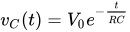
In the circuit, the capacitor is initially charged and has voltage Failed to parse (MathML with SVG or PNG fallback (recommended for modern browsers and accessibility tools): Invalid response ("Math extension cannot connect to Restbase.") from server "https://wikimedia.org/api/rest_v1/":): {\displaystyle V_0} aross it, and the switch is initially open. At time , we close the circuit and the capacitor will discharge through the resistor. The voltage across a capacitor discharging through a resistor as a function of time is given as:

Failed to parse (MathML with SVG or PNG fallback (recommended for modern browsers and accessibility tools): Invalid response ("Math extension cannot connect to Restbase.") from server "https://wikimedia.org/api/rest_v1/":): {\displaystyle v_C(t)=V_0e^{-\frac{t}{RC}}}

Charging

If the capacitor is initially uncharged and we want to charge it by inserting a voltage source Failed to parse (MathML with SVG or PNG fallback (recommended for modern browsers and accessibility tools): Invalid response ("Math extension cannot connect to Restbase.") from server "https://wikimedia.org/api/rest_v1/":): {\displaystyle V_s} in the RC circuit:

File:RC charge schematic.jpg

The voltage across the capacitor is given by:

Failed to parse (MathML with SVG or PNG fallback (recommended for modern browsers and accessibility tools): Invalid response ("Math extension cannot connect to Restbase.") from server "https://wikimedia.org/api/rest_v1/":): {\displaystyle v_C(t)=V_0(1-e^{-\frac{t}{RC}})}

where .

The term RC is the resistance of the resistor multiplied by the capacitance of the capacitor, and known as the time constant, which is a unit of time. The value of the function will be 63% of the final value at Failed to parse (MathML with SVG or PNG fallback (recommended for modern browsers and accessibility tools): Invalid response ("Math extension cannot connect to Restbase.") from server "https://wikimedia.org/api/rest_v1/":): {\displaystyle t=1RC} , and over 99.99% of the final value at Failed to parse (MathML with SVG or PNG fallback (recommended for modern browsers and accessibility tools): Invalid response ("Math extension cannot connect to Restbase.") from server "https://wikimedia.org/api/rest_v1/":): {\displaystyle t=5RC} .

The magnitudes of the voltage and current of the capacitor in the circuits above are shown in the graphs below:

Capacitor
Voltage Current
Charge File:RC charge voltage.jpg File:RC charge current.jpg
Discharge File:RC discharge voltage.jpg File:RC discharge current.jpg

RL Circuits

Discharging

In the following circuit, the inductor initially has current flowing through it; we replace the voltage source with a short circuit at Failed to parse (MathML with SVG or PNG fallback (recommended for modern browsers and accessibility tools): Invalid response ("Math extension cannot connect to Restbase.") from server "https://wikimedia.org/api/rest_v1/":): {\displaystyle t=0} .

File:RL discharge schematic.jpg

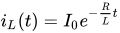
The current flowing through the inductor at time t is given by:

Failed to parse (MathML with SVG or PNG fallback (recommended for modern browsers and accessibility tools): Invalid response ("Math extension cannot connect to Restbase.") from server "https://wikimedia.org/api/rest_v1/":): {\displaystyle i_L(t)=I_0e^{-\frac{R}{L}t}}

Charging

If the inductor is initially uncharged and we want to charge it by inserting a voltage source Failed to parse (MathML with SVG or PNG fallback (recommended for modern browsers and accessibility tools): Invalid response ("Math extension cannot connect to Restbase.") from server "https://wikimedia.org/api/rest_v1/":): {\displaystyle V_s} in the RL circuit:

File:RL charge schematic.jpg

The current through the inductor is given by:

The time constant for the RL circuit is equal to Failed to parse (MathML with SVG or PNG fallback (recommended for modern browsers and accessibility tools): Invalid response ("Math extension cannot connect to Restbase.") from server "https://wikimedia.org/api/rest_v1/":): {\displaystyle L/R} .

The magnitudes of the voltage and current of the inductor for the circuits above are given by the graphs below:

Inductor
Voltage Current
Charge File:RL charge voltage.jpg File:RL charge current.jpg
Discharge File:RL discharge voltage.jpg File:RL discharge current.jpg